
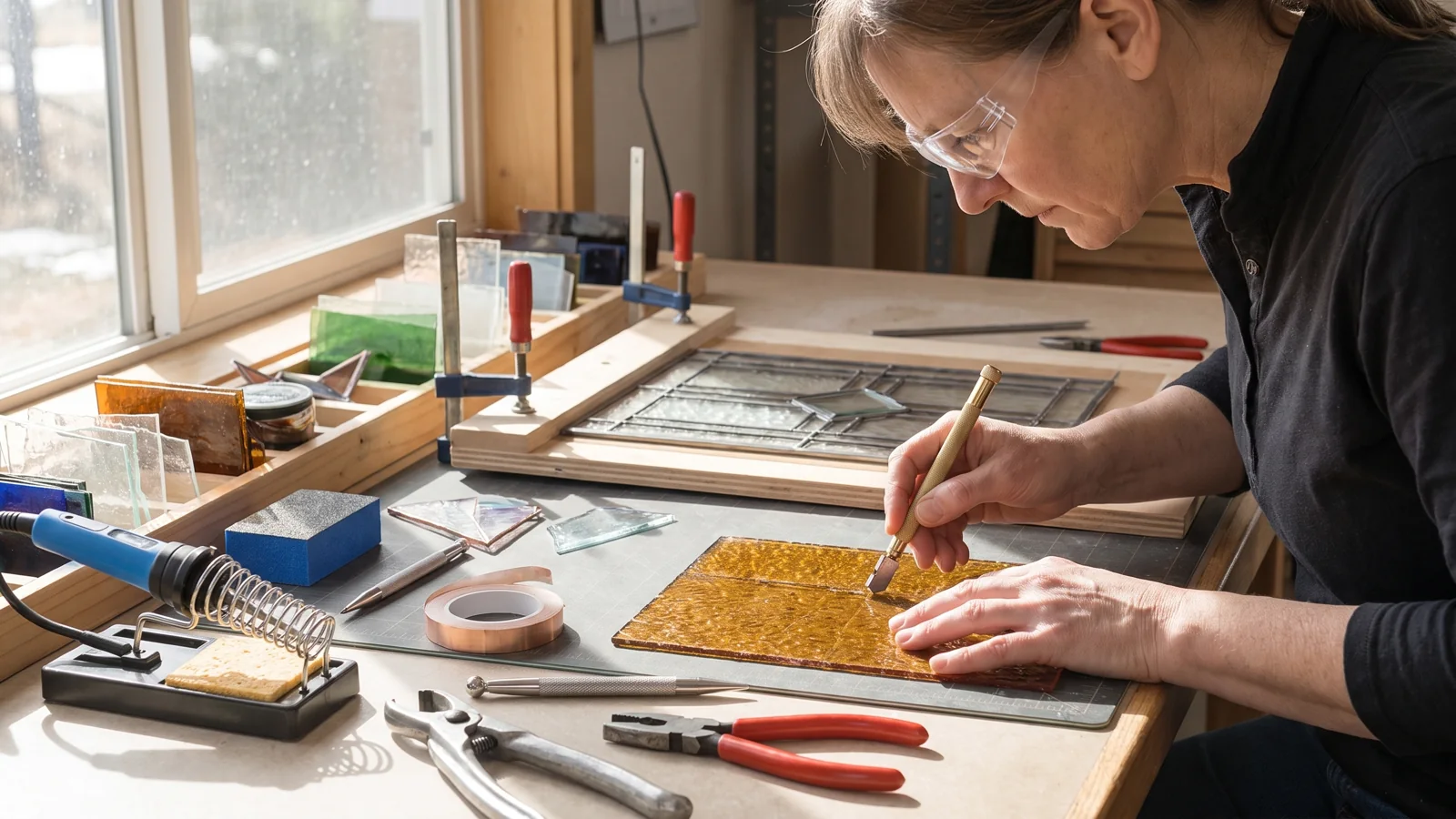
If you are searching for leaded glass classes in Colorado, you may be comparing two different stained glass construction methods: lead came and copper foil. Both use shaped glass and metal to create a finished design, but the assembly process, tools, and finished appearance can differ. Understanding that distinction can help you choose a class that matches your goals before you register.
Leaded glass, often called lead came stained glass, uses lengths of shaped metal channel to hold individual glass pieces together. The glass fits inside the channel, and the joints are soldered to connect the framework. The visible lead lines become part of the design, giving the finished panel a structured, traditional appearance.
Copper foil construction uses adhesive-backed copper foil around the edges of each glass piece. The foiled pieces are fitted together, then solder is applied along the seams. This method can accommodate detailed shapes and curved lines, while lead came creates a more defined framework around the glass. Neither technique is automatically better; the right choice depends on the project and the kind of process you want to practice.
A leaded glass class should explain more than the name of the technique. Students typically need to understand how a pattern is organized, how glass pieces relate to the metal channel, and how soldered joints contribute to the strength and appearance of the panel. A useful class also leaves time for demonstrations, supervised practice, and questions about safely handling glass and studio equipment.
It is also important to check the actual course listing before assuming that a studio offers lead came instruction. Scottish Stained Glass — Centennial Studio currently lists Copper Foil Level 1, Level 2, and Level 3 as its structured stained glass classes. The approved class descriptions focus on cutting, copper foiling, soldering, intermediate copper foil techniques, and advanced copper foil projects. Those listings should not be treated as lead came classes.
For someone new to stained glass, Copper Foil Level 1 is the studio’s beginner option. The class lasts four hours, from 10am to 2pm, and costs $145. Its stated focus is learning cutting, copper foiling, and soldering. Students who want to build a foundation in stained glass can use this class to become familiar with the sequence of preparing glass, joining pieces, and completing a small project under instruction.
Students with previous copper foil experience can consider the next levels. Copper Foil Level 2 is an eight-hour, full-day class priced at $255 and focuses on intermediate copper foil techniques. Copper Foil Level 3 is an advanced, two-day class totaling 16 hours and priced at $450. It focuses on complex patterns and larger projects. These are progression options within copper foil, rather than a lead came curriculum.
The studio is located at 7075 S Alton Way, Unit W, in Centennial, Colorado, in the Denver metro area. Classes are held Monday through Saturday from 9:00 AM to 5:00 PM. The maximum class size is six, which can be useful for students who want access to direct instruction while working through unfamiliar tools or construction steps.
Materials are included for the listed classes. The studio provides all glass pieces, copper foil, soldering equipment and solder, cutting tools, safety glasses, aprons, and gloves. Students should bring closed-toe shoes and comfortable clothing because the work may involve flux. Checking the class details before attending is still a good way to confirm the schedule and any current preparation instructions.
If your goal is specifically to learn lead came, ask the studio whether a lead came course is currently available before booking. You can also describe the project you have in mind, such as a traditional geometric panel, a restoration-related study, or a design with prominent structural lines. This avoids registering for a copper foil class when your priority is a different assembly method.
For many first-time students, starting with copper foil is a practical way to learn core stained glass habits, including pattern planning, glass cutting, fitting, soldering, and studio safety. Those skills can help you evaluate future technique-specific instruction, even though copper foil experience does not by itself mean that a student has been trained in lead came.
To compare the available learning path, review the Copper Foil Level 1, Level 2, and Level 3 class pages, or ask about private instruction if you need a more tailored conversation. The studio also offers seasonal workshops and private sessions, but the approved listings do not identify those options as lead came classes. For current availability, contact Scottish Stained Glass — Centennial Studio at +1-866-846-5758 or ssg@scottishgroupcompanies.com.
Learn more Learn more Learn more Learn more
Does Scottish Stained Glass currently list a leaded glass class in Colorado? The approved class listings currently identify Copper Foil Level 1, Level 2, and Level 3, along with seasonal workshops. They do not identify a lead came class. Contact the Centennial Studio to ask about current offerings.
What is the difference between lead came and copper foil? Lead came uses metal channel to hold glass pieces, with joints connected by solder. Copper foil wraps the edges of individual glass pieces in copper tape before the pieces are fitted and soldered together.
What is the beginner stained glass class at the Centennial Studio? Copper Foil Level 1 is the listed beginner class. It lasts four hours from 10am to 2pm, costs $145, and covers cutting, copper foiling, and soldering.
Are materials included in the listed classes? Yes. Included materials are all glass pieces, copper foil, soldering equipment and solder, cutting tools, safety glasses, aprons, and gloves. Students should bring closed-toe shoes and comfortable clothing.